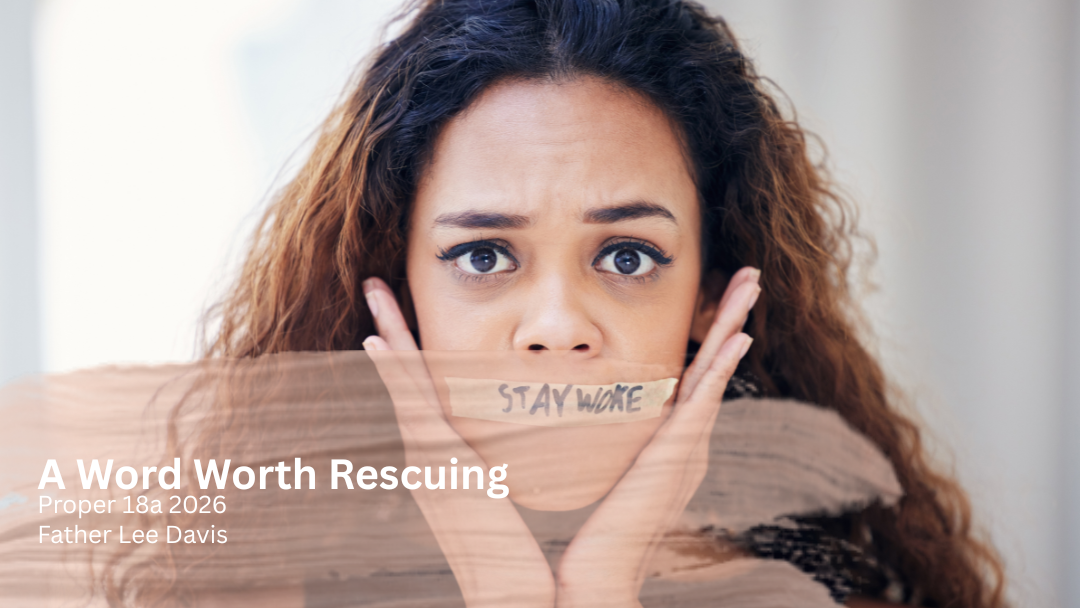

When Staying Awake Means Making Room
Isaiah 11:1-10, Matthew 3:1-12
In last week's blog, as we began Advent, I invited us to think about what it means to stay awake—to resist the temptation to go spiritually numb in a time when the news is heavy, our schedules are packed, and the future feels uncertain.
We talked about Advent as a season that doesn’t pretend everything is fine, but instead asks us to keep our eyes open for God’s presence and God’s promised future right in the middle of all that feels unsettled.
This week, the question shifts a little.
If Advent has nudged us to stay awake, then the next question is:
Once we’re awake… what do we do with what we see?
Because staying awake means we begin to notice things:
- the places in our own lives that feel overcrowded and exhausted,
- the strain in our relationships,
- the fear and anger that shape our public life,
- and yes, the quiet, stubborn signs of hope that keep breaking through in unexpected places.
Advent doesn’t just say, “Notice that.” Advent says, “Now, what needs to change?”
Enter John the Baptist (Ready or Not)
This Sunday, the Church gives us one of Advent’s most jarring voices: John the Baptist out in the wilderness. He doesn’t arrive with gentle background music. He doesn’t say, “Try to be a little nicer; that should do it.” He cries out a word many of us have heard used badly, but which we still need to reclaim:
Repent.
For some, that word has been loaded with shame and fear. It’s been used like a weapon instead of an invitation. If that’s part of your story, I want you to hear this: In Scripture, repentance is not about God rubbing your nose in the past. It’s about God opening a door to a different kind of future.
One simple way to say it is this:
Repentance means making room.
Making Room in a Crowded Season
Think about what your house looks like in December.
We add decorations, squeeze in extra events, rearrange furniture for the tree or the guests, rush from obligation to obligation. By the time we get to Christmas, many of us are over-full and under-nourished. It’s not just our homes that get crowded. Our inner lives do, too.
Our minds and hearts fill up with:
- noise and information,
- other people’s anger,
- our own worries about money, health, family, and the world,
- the constant feeling that we’re already behind.
In that kind of season, “staying awake” is only the first step. The second step is to ask:
“What is taking up so much room in me that there’s hardly any space left for God—or for anyone else?”
That’s where this Advent word repent comes in—not as a threat, but as an invitation to clear a little space.
Hope in “Stump” Seasons
Our reading this Sunday from Isaiah paints a powerful picture:
“A shoot shall come out from the stump of Jesse…”
A stump is what’s left after something has been cut down. It looks finished: no growth, no future, nothing to look forward to. There are parts of our lives, and parts of our common life as a community and a nation, that feel like that—cut down, worn out, stuck. Advent insists that even there, God is not finished. New life can push up from places we’ve written off. Fresh courage can grow where we thought we were done. A different kind of hope can take root where we only saw a stump. But here’s the rub: new growth needs room.
If everything is packed tight—our calendars, our habits, our assumptions—then even when God is doing something new, we may not have space to notice it, much less nurture it.
From Private Comfort to Shared Space
Last week, I talked about not sleepwalking through this season. This week, I think Advent presses us a little further:
Where do I need to make room—not just for my own comfort, but for someone else’s life?
That could look like:
- making room in my schedule to truly listen to someone who is lonely or struggling,
- making room in my budget to support the work of compassion and justice,
- making room in my imagination for the possibility that those I disagree with are still loved by God,
- making room in our church for people who don’t fit a neat mold—and who remind us that the Body of Christ is bigger than our preferences.
This is not about guilt. It’s about alignment—allowing our lives to line up more closely with the heart of Christ, who always seems to be making room: at the table, in his schedule, on the cross, in the tomb, and beyond.
So as we move into the second week of Advent, I’d like to offer a simple question to carry with you:
“Lord, where are you inviting me to make room?”
Not, “How can I fix everything?” Not, “How can I become a perfect Christian by Christmas?” Just: Where is one small place—one habit, one relationship, one corner of my life—where you are asking me to clear a little space? You don’t have to have the answer right away. You don’t have to announce it on social media or explain it to anyone else. Just bring the question with you into prayer, into your day, into this week’s worship.
We’ll explore more of this together on Sunday as we listen to John in the wilderness and Isaiah’s vision of a world made new. For now, in a season that keeps trying to fill every moment and every space, may you hear Advent’s quieter invitation:
Stay awake.
Notice what has taken over the room.
And dare—with God’s help—to make space for a different kind of life to grow.